
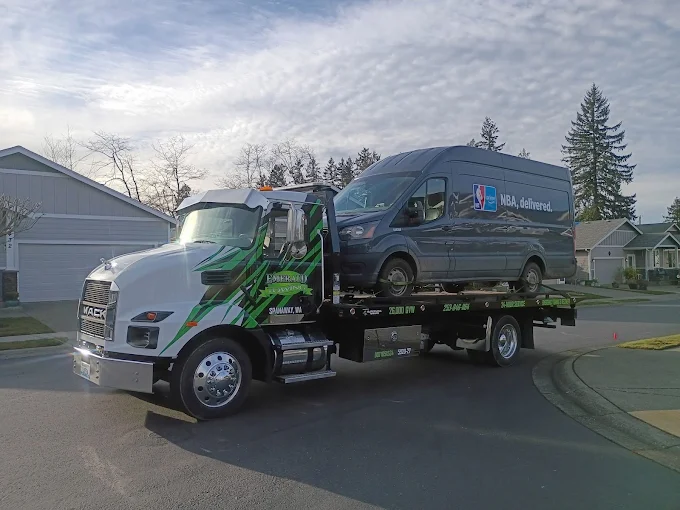
Delivery truck down on your route?
Tell us the vehicle, the load, and where you are. We'll get it moving fast, 24/7.
Getting Delivery Vehicles Off the Road and Routes Moving
When a delivery truck breaks down, packages stop moving and customers start waiting. Step vans, cargo vans, and delivery trucks each need the right size tow truck, and a little planning keeps the route on track while the vehicle heads to the shop.
Delivery vehicles work hard. They stop and start all day, idle at the curb, and pile on miles fast. That’s tough on brakes, batteries, transmissions, and tires.
Here are the delivery vehicles we tow most:
- Cargo vans: Full-size vans used for parcels, trades, and local deliveries. Many can go on a flatbed.
- Step vans: The tall, boxy walk-in vans used for parcel routes. These are heavier and taller and often need medium duty equipment.
- Box trucks: Used for furniture, appliance, and freight deliveries. See box truck towing.
- Refrigerated vans and trucks: Food and medical deliveries that can’t sit for long.
- Electric delivery vans: More fleets are adding these. Tell us up front, since most should ride with all four wheels off the ground.
Cargo first. If the load is time-sensitive or refrigerated, tell us right away. It may make sense for another vehicle to pick up the packages before the tow, so the route keeps moving.
We’re a family-owned towing company based at 20618 Mountain Hwy E in Spanaway, and we’ve been helping drivers and fleets around Pierce County since 1998.
Delivery Routes Around Spanaway
From our shop on Mountain Highway East, State Route 7, we reach delivery vehicles on routes across this part of Pierce County: Pacific Avenue, Frederickson’s warehouses, the neighborhoods off 176th Street East and SR 161, and the highways connecting them.
- Pacific Avenue (SR 7): Retail and residential deliveries through Spanaway and Parkland, with lots of stops and turns.
- Frederickson and Canyon Road East: Warehouses and distribution sites where many routes start and end.
- Neighborhoods off 176th Street East, 112th Street East, and SR 161: Residential routes in Spanaway, South Hill, Graham, and Frederickson.
- SR 512 and I-5: Routes heading to Lakewood, Tacoma, and Puyallup.
- Rural roads along SR 507 and in Graham and Roy: Longer routes with gravel driveways and soft shoulders.
- JBLM: Deliveries on or near base. Tell us when you call, since access can take extra steps.
Rural routes come with their own trouble. A step van that backs into a soft gravel driveway after a rainy week can sink fast. If you’re stuck but the van runs fine, a winch out may be all it takes.
Stuck in a customer's driveway?
Call with how it's sitting. A winch out may get you back on the route.
Roadside Fixes vs. a Tow
Dead batteries, flats on a good wheel, empty tanks, and lockouts are common on delivery routes and can often be fixed on the spot. Brake, transmission, overheating, or crash damage usually means a tow.
Quick fixes that can keep a route going:
- Dead battery: All-day stops and idling wear batteries down. A jump start or battery service may do it.
- Flat tire: A tire change if there’s a good spare and the wheel isn’t damaged.
- Empty tank: We can tow you to the nearest gas station.
- Locked out: A lockout call, not a tow.
A tow is the safer choice when the brakes feel wrong, the transmission slips, the engine overheats again, there’s a leak or smoke, or the vehicle was in a crash. Most rear-wheel drive step vans need the driveshaft handled before towing.
Fleet Accounts and What Affects the Cost
Delivery vehicle tows are usually priced on a hookup charge plus mileage. Fleets can speed up every call with an approval contact, a usual shop, and unit numbers ready.
- Vehicle size: A cargo van is a lighter job than a loaded step van.
- Prep: Driveshaft or air brake work on bigger vehicles.
- Distance: A short run to your shop costs less than a longer haul.
- Timing: Nights, weekends, and holidays can cost more with many companies.
For fleets and route owners, a little setup helps: a dispatcher or manager who can approve a tow any time, your usual shop with after-hours drop-off info, and unit or PO numbers for billing. See our commercial towing page for more. We believe in fair pricing and clear communication, so you’ll know what to expect before we roll. Call us at 253-846-1164.