
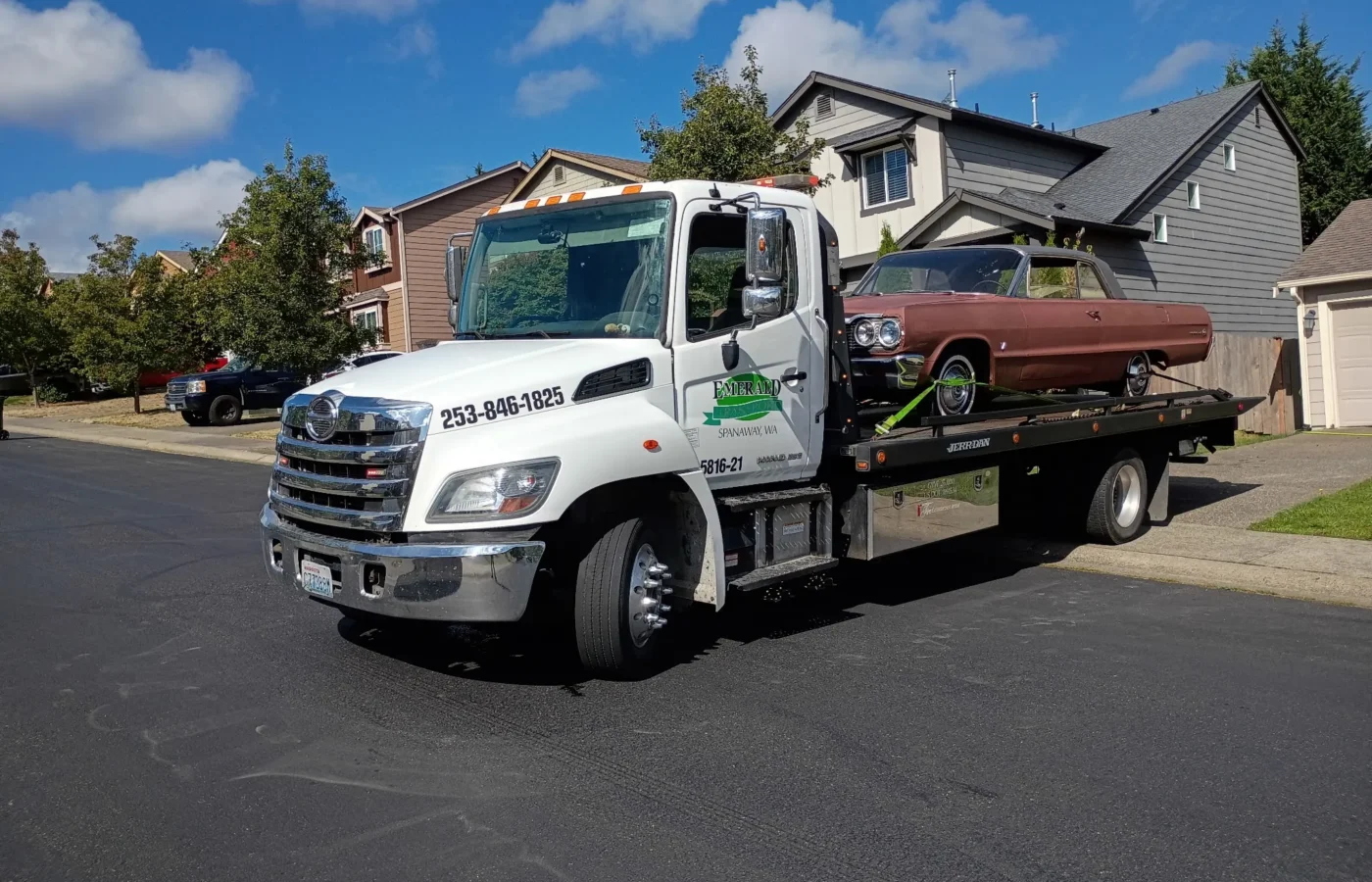
Need Car Hauling?
Call for a tow — a real dispatcher answers 24/7.
Decide If Your Vehicle Needs Flatbed Hauling or Standard Towing
If your car is all-wheel drive, sits low, won’t roll, is damaged, or is going a long way, it should ride on a flatbed with all four wheels off the road. A regular front or rear-wheel drive car that rolls fine and is only going a few miles can usually go with a standard wheel lift tow. When you’re not sure, tell us the make, model and condition, and we’ll help you pick.
There are two main ways to move a car. With car hauling on a flatbed, the whole vehicle sits on the truck bed, so no wheels touch the road. With a standard wheel lift tow, the truck raises one end of the car and the other two wheels roll behind.
Both work well. The right one depends on your car and the trip it’s taking.
A flatbed is the safer choice if any of these sound like your situation:
- Your car is all-wheel drive or four-wheel drive. When some wheels spin on the road while others are held still, the drivetrain can get damaged.
- It’s an electric or hybrid vehicle. Many makers say these shouldn’t be towed with drive wheels on the ground.
- It sits low, like a sports car or a lowered build. A flatbed keeps the front end and bumper from scraping. See low clearance towing.
- It’s a classic, luxury or collector car you want handled with extra care.
- It was in an accident, has a broken wheel or axle, or won’t steer or roll.
- It’s going a long distance, like a move across the state or out of Washington.
Long trips are a big one. Every mile on the road wears your tires and parts, and road grit and rain spray hit the car the whole way. On a flatbed, your odometer doesn’t move and your car arrives the way it left.
Now for the honest part. You don’t always need a flatbed.
Say you’ve got a front-wheel drive sedan with a dead starter, and it’s going to a shop a few miles down Mountain Highway. It rolls fine, steers fine, and has nothing hanging loose. A wheel lift tow can handle that just fine. It’s also handy in tight spots, like a narrow driveway or a packed parking lot, where a long flatbed has a hard time lining up.
So if your car is two-wheel drive, in good shape, and the trip is short and local, standard towing is a fair, sensible choice. We’d rather you get what fits than pay for more than the job needs.
If you’re stuck in the middle and aren’t sure what your car has, that’s normal. A lot of folks don’t know offhand if their SUV is all-wheel drive. Check your owner’s manual, look for an AWD or 4×4 badge on the back, or just give us the year, make and model when you call.
Tell us where the car is, where it’s going, and whether it runs, rolls and steers. That’s enough for us to tell you plainly which way makes the most sense, so there are no surprises when the truck shows up.
Know the Difference Between Car Hauling and a Long-Distance Broker
When you search for someone to move your car a long way, a lot of the companies that come up don’t own a truck. They’re brokers. A broker takes your order, then posts the job where carriers can see it, and a carrier they’ve never met may be the one who picks up your car.
A direct hauler is different. The company you call is the company that shows up, loads your car and drives it to where it’s going.
Neither one is a scam. They’re just two different ways of doing business, and it helps to know which one you’re talking to before you hand over your keys.
Here’s what tends to change when a broker is in the middle:
- The price you’re quoted is what the broker thinks a carrier will accept. If nobody takes the job at that price, the quote can go up or the wait can stretch out.
- You usually get a pickup window of a few days, not a set time.
- You may not know the name of the driver or the truck until close to pickup day.
- Your car may ride on a big open carrier with several other cars, loading and unloading along the way.
With a direct hauler, you talk to the people who’ll handle your car. You can ask how it’ll be loaded, when the truck is coming and what happens if the weather turns. And you get the answer from the folks doing the work.
Now, to be fair, brokers make sense for some trips. If you’re shipping a running car clear across the country and you’re flexible on dates, a spot on a multi-car carrier can be the cheaper way to go. That’s a real option, and we won’t pretend it isn’t.
Where it gets tricky is when timing matters or the car needs extra care. Say you’re stationed at JBLM, right next door to Spanaway, and your orders came with a tight report date. Or you’re sending an all-wheel drive car or a classic that should ride alone on a flatbed, as we covered above. A loose pickup window and a stranger’s truck aren’t what you want in those cases.
Before you book with anyone, ask these questions:
- Are you the company that will haul my car, or are you arranging it with someone else?
- Will my car ride alone on a flatbed or on a carrier with other vehicles?
- Is this price firm, or can it change before pickup?
- What day and time will the truck arrive?
- Who do I call if something comes up while my car is on the road?
A good company won’t dodge any of those. If the answers are vague, that tells you something.
Our car hauling, long distance towing and vehicle transport are all handled by our own team. We’re a family-owned company that’s been serving Pierce County since 1998. When you call us, you’re talking to the same people who’ll take care of your car from pickup to delivery.
Common Reasons Spanaway Drivers Need a Vehicle Hauled
Most car hauling isn’t about a breakdown on the side of the road. It’s about a car that needs to be somewhere else, and driving it there isn’t a good idea or isn’t possible.
Here are the reasons that come up most often, so you can see where you fit.
You’re moving, and you’ve got more cars than drivers. A family heading out of Pierce County might have two vehicles and one person who can drive. Or orders out of JBLM mean you’re flying while your car has to follow. Hauling lets the car get there without anyone putting a few hundred extra miles on it.
You bought a car that isn’t close to home. Maybe you found the right truck from a private seller in another town, or a dealer across the state had the model you wanted. Instead of taking a day off to drive there and back, you can have it brought to your driveway.
Your car doesn’t run, and it needs to get to a shop. A blown engine, a bad transmission or a car that’s sat too long can’t make the trip on its own. We can move it to the mechanic you trust, even if that shop isn’t the closest one.
You’ve got a project car or classic that needs care. Taking a restoration to a body shop, an upholstery place or a car show is a lot of risk to put on old parts and fresh paint. This is where a flatbed, as we covered above, really earns its keep.
You sold a car and the buyer isn’t local. Sometimes you need to deliver it to them, or they ask you to set up the hauling. Either way, the car shows up without miles or wear added on the way.
You’re moving a car in or out of storage. Folks park a summer car, a spare vehicle or a deployed family member’s car for months. When it’s time to bring it home, the battery may be dead and the tires low. Hauling skips the hassle of getting it road ready first.
A few related jobs have their own pages, but they’re worth knowing about:
- If the car’s done for good, junk car removal may be the better fit.
- Bikes ride on their own setup with motorcycle towing.
- Small machines like a skid steer go under equipment transport for light machinery.
- Older and collector cars get extra attention with classic car towing.
If your reason isn’t on this list, that’s fine. The questions stay the same: where is the car now, where does it need to go, and does it run, roll and steer? Once we know that, we can tell you plainly how we’d move it.
We’ve been helping Spanaway, Tacoma, Puyallup, Graham, Lakewood and JBLM families move their vehicles since 1998. We’d be glad to help with yours.
Need a car moved?
Call to schedule — tell us where it is, where it's going, and if it runs.
What Happens During Pickup and Delivery
Knowing what pickup day looks like takes a lot of the worry out of it. Most car hauling jobs follow the same basic steps, and there are a few small things you can do to make yours go smoothly.
Before the truck comes, a little prep goes a long way:
- Take out personal items, loose stuff in the trunk and anything that could slide around. Hauling companies generally aren’t set up to be responsible for things left inside.
- Pull your toll pass or parking tags off the windshield so they don’t get charged along the way.
- Take clear photos of every side of the car, plus any dings or scratches you already know about. Your phone’s date stamp is your friend here.
- Have the keys ready, including any spare or fob the car needs to start or shift into neutral.
- Let us know about anything unusual, like a car alarm that goes off easily, a parking brake that sticks or a steering lock.
It also helps to tell us about the spot where the car is sitting. A flatbed is a long truck. A steep gravel driveway, a locked gate, a low carport or a car tucked behind a fence all change how the truck lines up. If we know ahead of time, there’s less guessing when the truck pulls up.
At pickup, the car gets a look-over before it’s loaded. This is a good time to walk around it together and point out any damage that’s already there. If there’s paperwork describing the car’s condition, read it before you sign. Make sure it matches what you see.
On a flatbed, the bed tilts down to make a ramp. A car that runs can often be driven up slowly. A car that won’t start or roll gets pulled up with a winch. Once it’s on, it’s strapped down so it can’t shift while it’s moving. Then the bed levels out and the car rides the whole way with all four wheels off the road.
Someone with the keys should be at both ends of the trip. If you can’t be there, that’s okay. Just let us know who will meet the truck and how to reach them, so nobody’s left waiting in a driveway.
At delivery, do the same walk-around you did at pickup. Compare the car to your photos before you sign anything. Check the bumpers, the lower edges and the wheels, since those are the spots closest to the ramp and straps.
If something doesn’t look right, say so right then and write it down on the delivery paperwork. A note made on the spot is much easier to sort out than a call a week later. If everything looks good, start the car if it runs, check the dash for warning lights and you’re done.
That’s really all there is to it. Clear photos, a quick walk-around at each end and a heads-up about anything tricky make for a calm pickup and a car that shows up the way it left.
Ready to set up a pickup?
We'll confirm the day, the truck and the drop-off before we roll.
When You Don’t Need Car Hauling
Hauling is a great fit for a lot of situations. It isn’t the answer every time, though. Here’s when we’d tell a neighbor to skip it.
First, your car runs well and you have someone to drive it. If the car is safe, legal to drive and in good shape, and you or a family member has the time, driving it there is usually the simplest and cheapest way. That’s true even for a longer trip.
Lots of people move a second car this way. One person drives and the other follows, or a friend helps out for a weekend. If nobody minds the miles, there’s no reason to pay for a truck.
Second, the problem can be fixed right where the car is. A car that won’t go isn’t always a car that needs to be moved. Many common hang-ups take a few minutes to sort out on the spot:
- Dead battery: a jump start may be all it needs.
- Flat tire: a tire change can get you rolling again.
- Out of gas: We can tow you to the nearest gas station.
- Keys locked inside: car lockout help gets you back in.
If one of those gets the car running and it drives normally afterward, you can take it where it needs to go yourself.
Third, the repair might happen where the car sits. Some shops and mobile mechanics will do smaller jobs in your driveway. That can include things like a starter, a battery cable or brakes. If your mechanic can come to you, call them before you set up a haul.
Fourth, the car isn’t worth the trip. Sometimes the repair bill would cost more than the car is worth. In that case, paying to haul it to a shop just delays a hard decision. Junk car removal may make more sense, as we mentioned earlier.
Fifth, you’re not in a hurry and the car just needs a little attention. Say a car has been parked in the yard for a few months. If the battery takes a charge, the tires hold air and the car starts and drives fine, you may not need a truck at all. Give it a careful once-over first. Check the tires, brakes and fluids, and listen for anything that sounds off before you head out on the road.
There are also times you should wait instead of driving. Don’t drive it if the car is leaking fluid, the brakes feel soft, a warning light is flashing or the steering pulls hard. That’s when hauling makes sense, as we covered at the top of this page. Pushing a sick car a few more miles can turn a small repair into a big one.
The point isn’t to talk you out of anything. It’s to make sure you’re paying for what the job really needs. If the car runs, drives safely and someone can take it, go ahead and drive it. If it can’t, call us at 253-846-1164.