Need a flatbed?
Tell us the make, model and whether it's AWD, electric or damaged. We'll send the right truck 24/7.
Flatbed Towing Is Required, Not Just Preferred, for Certain Vehicles
Some vehicles shouldn’t be towed with any wheels on the road. All-wheel drive, electric, low-clearance, and crash-damaged vehicles are the most common examples. If yours is one of them, a flatbed is the safe way to move it, not a bonus.
A lot of folks think a flatbed is just the gentler option. Sometimes that’s true. For some vehicles, though, it’s the only option that won’t cause new damage on the way to the shop.
Here’s why. A regular tow lifts one end of your car and rolls the other end on its own tires. The wheels still on the ground keep turning, and so do the parts connected to them. On some vehicles, that spinning wears out parts that were never built to turn without the engine running.
These are the vehicles we’d tell you to put on a flatbed every time:
- All-wheel drive and four-wheel drive vehicles: All four wheels are tied to the drivetrain, so rolling any of them can strain the transmission or transfer case. Many Subarus, SUVs, and pickups fall into this group.
- Electric and hybrid vehicles: When the wheels turn, the motor can turn too, and it may try to make power it has nowhere to send. Most makers tell owners to haul these with all wheels off the ground.
- Low cars and specialty vehicles: Sports cars, lowered cars, and cars with long front bumpers can scrape or crack when one end is tipped up. Classic and luxury cars belong here too, because their parts are hard to replace.
- Motorcycles: A bike needs to be strapped down standing upright on a flat deck, not dragged behind a truck.
- Vehicles damaged in a crash: A bent wheel, a broken axle, or a flat that won’t hold air can’t safely roll on the road, even at low speed.
Not sure what your car is? Check your owner’s manual. Look for a section on towing or flat towing. If it says to keep all wheels off the ground, that settles it. You can also check for a badge on the back that says AWD, 4WD, 4×4, or Hybrid. If you see one, tell us when you call. It helps us send the right truck the first time.
This matters around Spanaway. Plenty of drivers here run trucks and SUVs that handle wet Pierce County roads well. Those are often the same four-wheel drive and all-wheel drive vehicles that need a flatbed when they break down.
Here’s a common situation. Your crossover won’t start in a parking lot off Mountain Highway. It looks like a regular car, so you figure any tow truck will do. Then you notice the AWD badge on the tailgate. That small detail is the reason to ask for a flatbed before the truck heads your way.
If your car is front-wheel drive with no damage, a wheel-lift tow is usually fine, and we’ll tell you so. But if your vehicle is on the list above, please don’t let anyone talk you into a cheaper method. A short tow done the wrong way can turn into a much bigger repair bill.
We also handle motorcycle towing, classic car towing, luxury vehicle towing, and low clearance towing. Each of those has its own page if you want more detail on your vehicle.
Accident Damage and Non-Running Vehicles Need Full Flatbed Support
If your car won’t run or it’s been in a wreck, it needs to ride all the way on the deck. A car that can’t drive itself often can’t roll freely either, and dragging it makes things worse.
A lot of people don’t realize how much a modern car depends on power just to move. When the battery or engine is dead, the steering wheel can lock. The transmission can stay stuck in park. An electronic parking brake may not let go at all.
Try to tow that car with two wheels on the road and those wheels may not turn. They skid instead. That can flat-spot your tires and strain parts that were already having a bad day. A flatbed solves that. The car gets pulled up onto the bed and strapped down, so it doesn’t matter whether the wheels spin, steer, or stay locked.
After a crash, there’s another reason to keep everything off the ground. Damaged cars tend to come apart a little at a time:
- A cracked bumper or loose fender can hang low and catch the road.
- Broken glass and trim can fall off on the way.
- Coolant, oil, or other fluids may be leaking.
- A hood or door that won’t latch can swing open.
On a flatbed, the whole car is held in place. Loose pieces stay with it, and nothing scrapes along the road behind a truck. It also keeps the damage just the way the crash left it. That’s helpful when an insurance adjuster or body shop looks it over. They see what happened in the wreck, not new scrapes from the trip there.
Here’s a situation plenty of folks run into. A car sits in the driveway through a long, wet winter. Come spring, the battery’s dead, two tires are flat, and it won’t shift out of park. It isn’t wrecked, but it can’t roll either. That’s a flatbed job, plain and simple.
When you call us, a few quick details help us send the right truck and get your car loaded without surprises:
- Running: Does it start, or is it completely dead?
- Neutral: Can you shift it into neutral?
- Wheels: Do they turn, or is anything bent, flat, or locked up?
- Damage: Are any parts hanging loose or leaking?
- Location: Is it on a road, in a parking lot, in a driveway, or off in a ditch?
- Keys: Do you have them?
Don’t worry if you don’t know every answer. Just tell us what you can see, and we’ll take it from there.
If the car has slid off the road or into a ditch, it may need to be pulled out before it can be loaded. Our winch out service covers that part. If you’re calling from the scene of a wreck, our accident towing page explains more about that kind of call.
Car won't run or was in a wreck?
We'll load it all the way on the deck. Call with what you can see.
When You Don’t Need Flatbed Towing
Not every breakdown needs a flatbed. Some don’t need a tow at all. If your car starts, rolls and steers, and nothing is broken or leaking, a wheel-lift tow or a quick roadside fix may be all you need.
We’d rather tell you that up front than send a bigger truck than the job calls for.
If your car runs, rolls, and steers, and it isn’t on the list above, a wheel-lift tow is usually just fine. That covers a lot of everyday cars, like a front-wheel drive sedan or hatchback with no crash damage. The front wheels come up, the back wheels roll, and nothing gets hurt along the way.
A wheel-lift truck can also be the better choice in some spots. A flatbed is long and needs room to tilt its deck and pull a car up. In a tight parking lot, a narrow driveway, or a garage with a low ceiling, a shorter truck may be the only one that can reach your car. In that case, we’ll talk it through with you and pick the safest way to get it out.
Then there are the days when your car doesn’t need to go anywhere. A lot of roadside problems can be fixed right where you’re parked:
- Dead battery: If the car clicks but won’t crank, a jump start may get you going. If the battery’s worn out, we also offer battery service.
- Flat tire: If you have a good spare, a tire change usually beats a tow.
- Out of gas: We can tow you to the nearest gas station.
- Locked out: Car lockout help gets you back inside without a trip to the shop.
- Stuck but not damaged: If you slid into a soft shoulder or a muddy ditch and the car still drives fine, a pull out may be all you need.
- Running hot: Overheating assistance can sometimes sort it out on the spot, depending on the cause.
Some of these you may be able to handle yourself. If you’ve got jumper cables and a friendly neighbor, or a spare and the know-how to change it, go for it. Just do it only if you’re somewhere safe and well off the road. If you’re on a busy shoulder or it’s dark and raining, let someone come to you.
Sometimes the right move is just to wait a bit. If a warning light comes on but the car drives normally, you may be able to get it to your own mechanic on your own. If the engine got hot, let it cool down before you decide anything. A car that seems dead at first sometimes turns out to have a simple fix.
Here’s how to tell if you’re in tow territory. Ask yourself three things. Will it start? Will it roll and steer? Is anything broken, bent, or leaking? If the answer to all three is good news, you likely don’t need a flatbed. You may not need a tow at all.
When you call, just describe what’s going on. If a jump or a tire change will solve it, we’ll say so. If a wheel-lift tow is the right fit, we’ll tell you that too. You shouldn’t pay for more than your situation needs.
How to Confirm a Legitimate Flatbed Towing Operator Before You Hire
A legitimate tow company will give you its full name and address, confirm it’s sending a flatbed, and explain how the price is figured before it rolls. A few quick questions on the phone can save you a big headache later.
Start with the basics. A legitimate towing company will give you its full business name and a real address without any fuss. If someone won’t say where they’re based, or the name on the truck doesn’t match the one you called, that’s a red flag.
In Washington, tow operators who handle certain kinds of tows, like impounds and police calls, have to be registered with the state. It’s fair to ask any company whether they’re registered and insured. A real operator won’t mind the question.
Next, make sure the truck matches your car. If your vehicle is one of the types covered above, say so plainly and ask, “Are you sending a flatbed?” Get a clear yes. If a wheel-lift truck shows up for an AWD SUV or an electric car, you can say no before anyone hooks it up.
Then ask how the price is figured. Every tow company sets its own rates, but most bills are made up of the same few parts:
- A base or hook-up charge to load your car
- Mileage, based on how far it’s going
- Extra time or equipment, like a winch out of a ditch
- Night, weekend, or holiday calls, which can cost more with some companies
- Storage, if the car has to sit in a yard before it goes to the shop
You don’t need an exact number to the penny. You just want to know what you’re being charged for, so the bill at the end doesn’t surprise you.
Be careful with tow trucks you didn’t call. After a wreck, a truck sometimes pulls up before anyone has phoned for one. You don’t have to use it. You can call the company you choose, or the one your insurance sends.
Before your car leaves, a few simple habits protect you:
- Take a few photos of all four sides of the car.
- Confirm where it’s going, whether that’s a shop, your home, or a yard.
- Don’t sign a blank form or one you haven’t read.
- Ask for a written or emailed receipt that lists the charges.
None of this is about being suspicious of everyone. Most tow operators are honest, hardworking people. These steps just make sure you know who has your car, how it’s being moved, and what you’ll pay.
You’re welcome to ask us every one of these questions. Emerald Towing has been family-owned and operated since 1998, and you’ll find us at 20618 Mountain Hwy E right here in Spanaway. We believe in clear communication and fair pricing, and we’re here 24/7.
Want a straight answer before we roll?
Ask us anything. Name, address, truck type and how the price works.
What Happens During a Flatbed Tow, From Pickup to Delivery
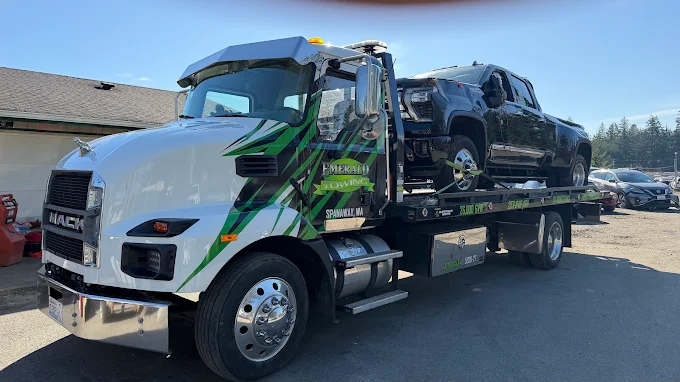
The deck tilts down to make a ramp, your car is driven or winched up slowly, strapped at all four corners, and carried with all four wheels off the road. At drop-off, the same steps happen in reverse.
If you’ve never watched a flatbed tow up close, it can look like a lot is going on. It’s simpler than it seems. Here’s how it generally goes, so nothing catches you off guard.
- The truck lines up: It parks in line with your car, usually in front of it. The driver turns on the warning lights and takes a quick look around. They check how your car is sitting, whether the wheels turn, and if anything is hanging low or leaking.
- The deck tilts down: It slides back until its end rests on the ground. That makes a gentle ramp. This is why a flatbed needs some room behind and in front of it to work.
- Your car goes up the ramp: If it runs and drives, it may be driven slowly onto the deck. If it doesn’t, a cable from the winch hooks to a solid point under the car and pulls it up nice and slow.
- It gets tied down: A good load is held at all four corners, usually with straps around the tires or chains to solid points on the frame. Your car shouldn’t shift, bounce, or roll at all during the trip.
- The deck levels out: It slides forward, and your car rides flat with all four wheels off the road. The transmission, axles, and motor stay still the whole way.
While this is happening, here’s what you can do:
- Stay safe: Stand somewhere away from traffic and away from the back of the truck while the car is moving up the deck.
- Grab your things: Take anything you’ll need before it’s loaded, like your wallet, phone charger, house keys, medicine, or a child’s car seat.
- Leave the key: Give the car key to the driver if it’s needed to steer or shift the car.
- Ask about a ride: Ask how you’ll get to where you’re going. Some companies let a passenger ride along and some don’t, so it’s worth asking up front.
The drive itself is the easy part. Your car might be headed to a shop in Tacoma or Puyallup, back to your driveway in Spanaway, or across the county. Either way, it rides the whole trip the same way it was strapped down.
At the drop-off, it all happens again in reverse. The deck tilts down, the straps come off, and the winch lets the car roll down slowly so it doesn’t slam into the ground. Then it’s set where the shop or you want it.
Before the truck pulls away, take a quick walk around your car. It should look the same as it did when it was loaded. With a flatbed, the tires never touched the road, so there shouldn’t be new scrapes, worn spots, or damage underneath.
That’s what we mean when we talk about protecting your vehicle from pickup to delivery. If you have a question at any step, just ask. We’ll explain what’s happening and why, any hour of the day or night. Call us at 253-846-1164.